


Immunoassay Analyzer
Why Choose Us
Our Factory
REALY has a dedicated development facility having a large pool of experienced scientists who are committed to development of IVD Reagents. Our R & D scientists are engaged in process development, process improvement, formulation and analytical development.
Certificate
CE certificates, ISO 13485 quality system certification, Manufacture License, Marketing Authorization in the country of origin.
Service Regions
Real Tech' s sales network has covered more than 80 countries and areas, providing an exciting opportunity for distribution of quality products at a very competitive price. We are dedicated to making the world a better place by providing people with high quality products and services.
Our History
Each year we participate in medical shows in various countries such as Medlab, Medica and AACC etc. We have got CE certificates, ISO 13485 quality system certification, Manufacture License, Marketing Authorization in the country of origin.
What is Immunoassay Analyzer?
An immunoassay analyzer is a laboratory analyzer used to identify and quantify specific substances. An antibody (e.g., immunoglobulin) is usually used as a reagent to detect a substance (e.g., antigen, hapten). These analyzers usually include an autosampler. Reagent dispenser, washer and detection system.
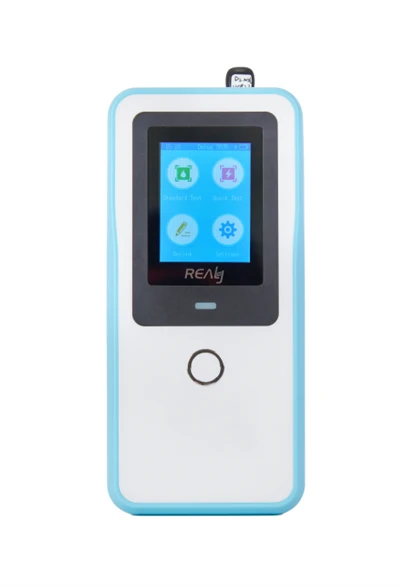
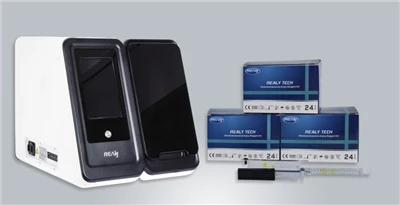
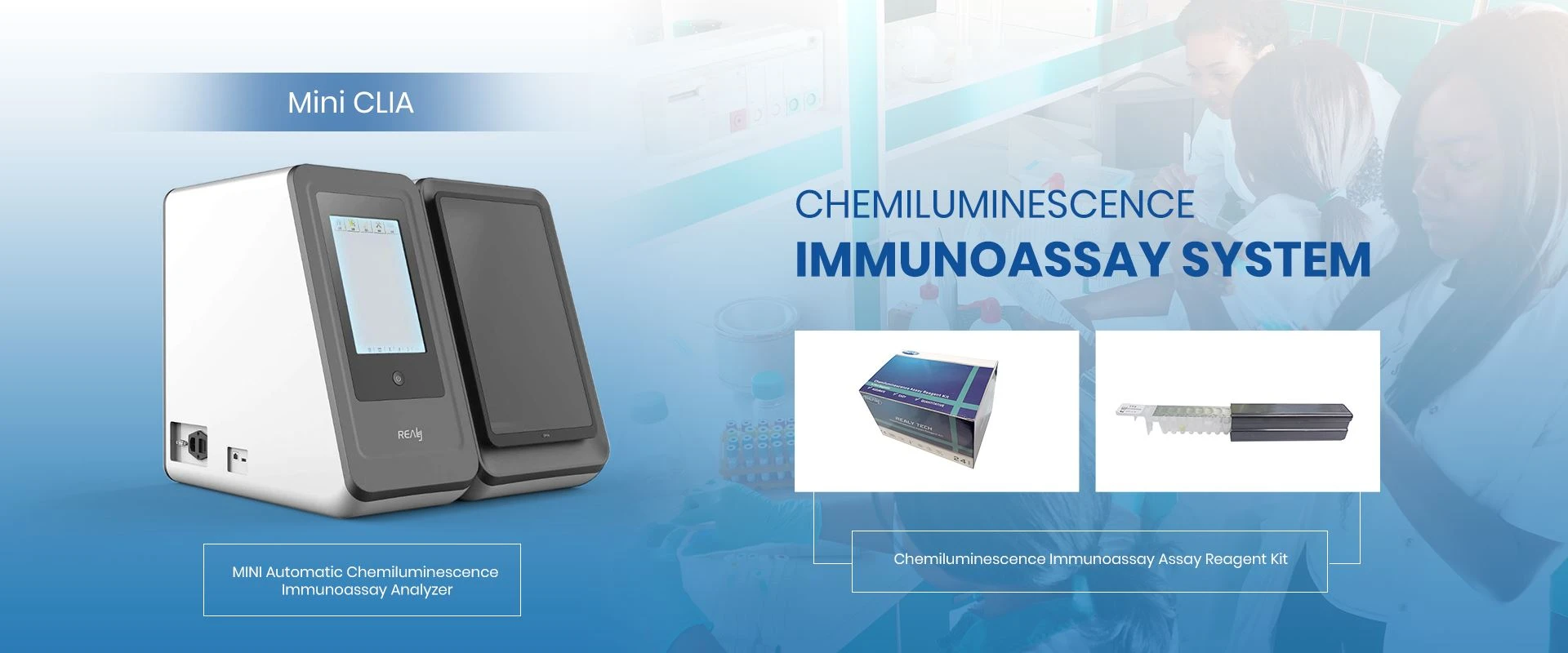
POCT Quantitative Immunoassy Analyzer RL-A2000
Chemiluminescence Immunoassay System
MINI Automatic Chemiluminescence Immunoassay Analyzer
Kinds Of Immunoassay Analyzer
Enzyme-linked immunosorbent assays (ELISAs)
All ELISAs feature an enzymatic reaction whose activity indicates analyte concentrations. ELISAs typically use one of two enzymes whose reactions can be monitored: horseradish peroxidase and alkaline phosphatase. The former uses hydrogen peroxide as an oxidizing reagent, causing the solution to emit a blue color whose intensity indicates analyte concentrations. The latter mediates a reaction that takes off a phosphate molecule from a molecule called adamantyl 1,2-dioxetane phosphate. As the 1,2-dioxetane decomposes further degrades, the solution emits a blue color whose intensity increases with increasing analyte concentrations.
Fluorescence immunoassays (FIA)
In an FIA, the detection antibodies are conjugated with compounds called dyes that emit a fluorescent color. This emission occurs through the photoelectric effect (insert link to the confocal microscopy) after the dyes are exposed to light at the maximum absorption wavelength. Many fluorescent dyes have been attached to the detection antibodies, including fluorescein and rhodamine B. The color dye used for a given antibody can help distinguish specific analytes within the same solution.
Chemiluminescent immunoassays (CLIA)
In a CLIA, detection antibodies are tagged with a molecule that lights up after a chemical reaction. These assays are different from ELISAs because the chemical reactions take place with a catalyst that’s not an enzyme. These assays also differ from FIAs because the light is emitted not from light absorption, but from a chemical reaction. These differences allow CLIAs to have a high range of quantification and improved sensitivity for detecting analytes.
Antibodies
By measuring the amount of specific antibodies in a sample, you can infer the amount of antigens present.
D-dimers
These proteins are fragments of fibrin, the main component of blood clots. They appear in the blood when clots dissolve. They are involved in everything to do with inflammatory reactions, particularly in blood vessels.
CRP
C-reactive proteins (CRP) are synthesized by the liver when there is inflammation or infection in the body.
Hormones
Hormone levels can be measured to determine the amount of growth hormones or thyroid hormones present. These assays use antibodies specific to the hormones of interest.
Tumor markers
Certain proteins serve as tumor markers, and are used in particular for oncology applications.
Types And Variations Of Immunoassay Analyzer
Radioimmunoassay
The radioimmunoassay is perhaps the oldest types of immunoassays. Here, a radioisotope is attached to an antigen of interest and bound with its complementary antibody. Then a sample with the antigen to be measured is added. It competes with the radioactive antigen, kicks it out of the binding spot and replaces it. After washing away unbound antigens the radioactivity of the sample is measured. The amount of radioactive signal is inversely related to the amount of target antigen. The health hazards of using radioactive substances caused a movement toward safer methods.
Counting immunoassay
In a counting immunoassay, polystyrene beads are coated with many antibodies complementary to the target antigen. During incubation the beads bind to multiple antigens and group together into a large mass. Some beads remain unbound. The entire solution is passed through a cell counter and only the unbound beads are counted. The number of unbound beads is inversely proportional to the amount of antigen.
Enzyme-linked immunosorbent assay
The Enzyme-Linked Immune Sorbent Assay, also known as ELISA, determines various entities such as the presence of antibodies to an infectious disease and also detects and measures antibodies in human samples as a reaction to specific antigens. ELISA-tests are commonly used to test the concentration of Vitamin D, insulin, COVID-19 or hepatitis antigens in samples.
Fluorescence and Chemiluminescence Immunoassays
Besides the use of immunoassays based on colour intensity to detect antibodies in specimens, detection can also be done by fluorescent tracers and light-generating molecules. These are called Fluorescent Immunoassay (FIA) and Chemiluminescence Immunoassay (CLIA). The basis of these immunoassays is a variant of ELISA. The substrate used does not generate colour but emits light.
What Are The Performance Criteria For An Immunoassay Analyzer?
There are many technical criteria for judging the performance of an immunoassay analyzer, such as versatility, throughput, sample capacity, minimum sample volume, and so on. Here is a list of the main performance criteria:
Versatility
This refers to the number of different tests the analyzer can perform. The higher the number, the more versatile the analyzer.
Throughput
The number of tests performed per hour. Depending on requirements and the need to analyze large quantities of samples, it may be preferable to opt for a high-speed analyzer. As a reminder, this criterion cannot be applied to semi-automatic analyzers.
Sample capacity
This is the number of places on the rack where samples are put.
Minimum sample volume
This is the smallest amount of sample at which the device can detect the presence of antibodies. The smaller the volume, the more sensitive the device and the higher its performance.
Number of reagent positions
This is the number of reagents that can be loaded at the same time.
Reaction time
Here again, depending on your needs, it may be worth opting for an analyzer with a fast reaction time. Some devices offer a reaction time of around ten minutes, with the first results available in around twenty minutes.
Working Principles Of Luminescence Immunoassay Analyzer
Luminescence immunotechnology is a method that combines luminescence and immune responses to detect antigens or antibodies. It uses micro-multiplication technology with good sensitivity and specificity; the detection range is very wide, from traditional proteins, hormones, enzymes to drugs can be detected. Clinical applications are mostly automatic chemiluminescence immunoassay analyzer, automatic microparticle chemiluminescence immunoassay analyzer and automatic electrochemiluminescence immunoassay analyzer.
Chemiluminescence immunoassay technology is also called micro-multiplication technology, including two methods:
1. Competition law
The competition method is mostly used for the determination of small molecule antigen substances. Excess antibody coated with magnetic particles is added to the reaction cup and incubated with the antigen to be tested and the quantitative labeled acridinium ester antigen at the same time, so that the labeled antigen and the antibody (or the antigen to be tested and the antibody) combine to form a complex.
2. Sandwich method
The sandwich method is mostly used to determine the antigenic substances of macromolecules. The labeled antibody and the test antigen are combined with the coating antibody at the same time to generate a coating antibody—a complex of the luminescent antibody of the assay antigen.
This kind of immunoassay analyzer machine applies classical immunological principles, using monoclonal antibody reagents, magnetic particles as solid-phase carriers, alkaline phosphatase as markers, and luminescent agents using 3-(2'-helicaladamantane)-4-methoxy-4 -(3"-phosphoryl oxy)benzene-1,2-dioxetane (AMPPD). Small molecules are determined by the competition method or antibody capture method, while large molecules are determined by the sandwich method.
It is one kind of automatic immunoassay analyzer. The test specimen is mixed with the antibody-coated paramagnetic particles and the luminescent agent-labeled antibody in a reaction cup and incubated together to form a magnetic microbead-coated antibody-antigen-luminescent agent-labeled antibody complex.
When the magnetic particles flow through the surface of the electrode, they are attracted by the magnet installed under the electrode, and the free luminescent agent-labeled antibody is washed away by the buffer. At the same time, a voltage is applied to the electrode to make the luminescent marker ruthenium terpyridine [Ru(bpy)3]2+ carry out electron transfer on the surface of the electrode to produce electrochemiluminescence, and the light intensity is proportional to the concentration of the antigen to be tested. The immunosuppressive method is used for the detection of small molecular weight protein antigens; the sandwich immunoassay is used for the detection of large molecular weight substances.
Advantages Of Chemiluminescence Immunoassay Analyzer
High Sensitivity Of Immunoassay Analyzer
Sensitivity is the key to the superior performance of immunoassay analyzer. The sensitivity of some analyzers can reach 10 -16 mol / L (RIA for 10-12 mol / L). Another example is chemiluminescent substrates (such as AMPPD), the concentration of alkaline phosphatase can be detected than the chromogenic substrate to be sensitive 5 х 10 ^ 5 times.
Wide linear kinetic range
The luminescence intensity of chemiluminescence immunoassay is linear between 4 and 6 orders of magnitude with respect to the concentration of the measured substance. This is a significant advantage compared to the absorbance (OD) range of 2.0 for colorimetric enzyme immunoassays. Although RIA also has a wide range of linear kinetics, radioactivity limits its application.
Long duration of light signal
The glow type CLIA produces a light signal that lasts for hours or even a day. This certainly simplifies the experimental operation and measurement.
The analysis method is simple and fast
Most of the chemiluminescence immunoassay analyzers are one-step mode that only requires the addition of one reagent (or a combination of reagents).
Stable results, small error
The sample directly emits light on its own, without any light source irradiation, eliminating the impact of various possible factors (light source stability, light scattering, light wave selector, etc.) to the analysis. This makes the analysis results sensitive, stable and reliable.
Good safety and long service life
Chemiluminescent immunoassay analyzer eliminates the use of radioactive substances. So far, it has not been found to be harmful. Moreover, the reagents used for immunoassay are stable and can be stored for up to one year.
Limitations Of Automated Immunoassay Analyzer

Cost

Complexity

Sample types
Our Factory
REALY has a dedicated development facility having a large pool of experienced scientists who are committed to development of IVD Reagents. Our R & D scientists are engaged in process development, process improvement, formulation and analytical development. This facility is recognized by State Food and Drug Administration, Government of China. COVID-19 Antigen Rapid Test Kits are our main product, including professional tests and home rapid test.

Certifications


FAQ
As one of the most professional immunoassay analyzer manufacturers and suppliers in China, we're featured by quality products and good service. Please rest assured to wholesale cheap immunoassay analyzer from our factory. Contact us for more details.